Filed under: Patristics
Please pray for Sister Macrina, who blogs on the Fathers at A Vow of Conversation. She’s preparing to make her final profession as a Cistercian.
Born in Jerusalem, closely connected with the royal house of Edessa, Sextus Julius Africanus served as librarian at the Pantheon in Rome during the reign of Alexander Severus (third century). Talk about your inside tracks on history! They say his Chronicles filled many volumes, though only fragments survive. He corresponded with Origen, and he was an invaluable source for Eusebius.
Now, all the fragments have been collected, with two letters by Africanus, in one volume with and English translation and footnotes. Iulius Africanus: Chronographiae: The Extant Fragments is a very valuable book, whose pricetag certainly reflects that high value. Bryn Mawr Classical Review says:
Through the Chronographiae Africanus conceived the extraordinarily ambitious plan of fitting widely disparate strands of different histories into a biblical frame of time, beginning with Adam and culminating with the Resurrection. The resultant chronological system served as a basis for universal histories of which the Eusebian-Hieronymian version proved both influential and lasting. Perhaps the success of the latter ultimately guaranteed the dispersal and fragmentary survival of the model conceived by Africanus.
Hat tip: PaleoJudaica.
Many apologies for my relative silence. I’ve been down with some mystery bug, which seems to be affecting all major systems simultaneously. Last week I could barely stay awake. My fever broke Friday, but other symptoms are lingering. Raise an Ave for a poor blogger, please.
The Society of St. John Chrysostom promotes ecumenical dialogue of the east-west variety. Most members belong to Orthodox or Catholic churches. I’ve had the honor of speaking twice in the lecture series of the Youngstown-Warren, Ohio Chapter.
Next up in the series is Reverend Father Calinic Berger, patrologist, monk, and pastor. A visiting professor of dogmatic theology at St. Vladimir’s Theological Seminary, Father Calinic got his doctorate under the generation of patristic luminaries at CUA, and it shows. The program will begin with vespers on Tuesday, May 13, at 6:30 p.m. He will speak on the subject “Priesthood: Foundations and Reflections.” The program takes place at Holy Trinity Romanian Orthodox Church, which is at 626 Wick Ave., Youngstown, Ohio. For information, call 330-755-5635.
Butler’s Lives of the Saints, all the original volumes in the late 1800s editions, are available from the Internet Archive, here.
A regular visitor, who wishes to remain anonymous, put them up. Here are the details:
(The archive can sometimes be finicky or slow, so if you get an error, just try again later.)
The four volumes are labelled there as volume 1, volume 2, volume 7, and volume 10. Volume 1 is Jan-Mar; Vol. 2 is Apr-Jun; Vol. 3 is Jul-Sep; and Vol. 4 is Oct-Dec. I think the source of the numbering confusion is that these volumes were produced just by binding the individual months’ volumes three at a time, so bound Vol. 3 begins with original Vol. 7.
Anyhow, they’re there. They’re huge and painfully slow to read because they’re all stored as graphic images. I am continuing to work on OCRing and proofing them to produce more usable versions, but I must admit I’m not working very fast. You can see from the page images why it takes so long–the print quality is abysmal, the pages are huge, and the extensive footnotes are in very tiny type!
Several archeological sites of interest:
On Malta, where St. Paul was shipwrecked, there are tours of the remains of a first-century Hellenistic Jewish community: “ancient Jewish tombs … carry religious symbols and other engraved decorations, such as crosses, palm fronds, or doves with olive branches - or, in some cases, the Jewish seven-branched candlestick (menorah).”
In Egypt archeologists have found another underwater early Christian church: “Forty metres beneath the surface the divers discovered a complete portico of the temple of Khnum; two huge, unidentified columns; and four pollards from the Coptic era. Hawass said these pieces would remain on the river bed as they were too heavy to be lifted out the water. Early studies show that the pollards may be part of a Christian church that may have once been located in the area but for unknown reasons was demolished or destroyed.”
Jim Davila reports on digs related to the messianic claimant Shimon bar Kokhba. SBK was an anti-Roman Jewish rebel whose story is told by several of the Fathers. According to his contemporary Justin Martyr, Simon ordered Christians “to be lead away to terrible punishment” unless they joined his cause and cursed Jesus of Nazareth (First Apology 31.6).
And how often did the pagan Romans beat their wives? New books dig into the literary and archeological evidence, which Rodney Stark also discussed in The Rise of Christianity.
Polish archeologists have found a patristic-era church in the Sudan.
Gashwin clarifies that Cardinal Newman isn’t quite on his way to beatification yet.
Perhaps the Alleluias were a bit premature … Basically, what’s happened is that the miracle has been officially recognized by the panel of medical experts. Or rather, they have determined that there is no natural explanation for the healing seen in this case.
There are still a few more steps before the Beatification can be officially proclaimed.
Today’s the emperor Gratian’s birthday. He was a key player in the removal of the pagan Altar of Victory from Christian Rome. The eventual victory belonged to St. Ambrose. The story’s told here.
Gashwin Gomes brings us tidings of great joy: Cardinal Newman will soon be beatified.
Vatican City, Apr 23, 2008 / 03:12 am (CNA).- The Vatican has approved the beatification of Cardinal John Henry Newman, the English convert and theologian who has had immense influence upon English-speaking Catholicism, the Birmingham Mail reports.
John Henry Newman was born in 1801. As an Anglican priest, he led the Oxford Movement that sought to return the Church of England to its Catholic roots. His conversion to Catholicism in 1845 rocked Victorian England. After becoming an Oratorian priest, he was involved in the establishment of the Birmingham Oratory.
He died in 1890 and is buried at the oratory country house Rednall Hill.
The Catholic Church has accepted as miraculous the cure of an American deacon’s crippling spinal disorder. The deacon, Jack Sullivan of Marshfield, Massachusetts, prayed for John Henry Newman’s intercession.
At his beatification ceremony later this year, John Henry Newman will receive the title “Blessed.” He will need one more recognized miracle to be canonized.
The case of a 17-year-old New Hampshire boy who survived serious head injuries from a car crash is being investigated as a possible second miracle.
Two of the fundamental texts in patrology, imho, are Newman’s Essay On Development Of Christian Doctrine and The Church of the Fathers. (Others would add The Arians Of The Fourth Century. But I’m tempted to add his collected works as well.)
Patristic (and Vatican) soundings on the question of Communion on the tongue.
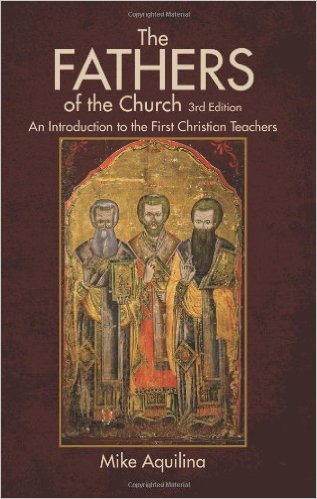
New Testament scholar Darrell Pursiful has posted a very generous review of my book The Fathers of the Church (Expanded Edition).
The Fathers of the Church by Mike Aquilina (Our Sunday Visitor, 2006) is an excellent reader for those wanting exposure to the writings of the early church. Aquilina writes well, but the benefit of most volumes of this nature is when the writer says as little as possible so as to let the primary sources speak for themselves. This is also something Aquilina does well. The book begins with a somewhat lengthy introductory essay dealing with the place of the early church fathers and their overall importance in the church’s theology, worship, and witness. Next comes over 200 pages of primary source material, prefaced by sufficient biographical information for each father to help the reader get her bearings but not so much as to be a distraction.
I’m honored. Read on.
Sorry for my absence. While Papa Benedetto was charming the people of the Eastern States (and a huge TV audience), I was away from all media on a father-son trip (planned long ago) to the Gettysburg Battlefield. I returned to looming, threatening, dark stormclouds of deadlines.
But there’s so much I’ve wanted to send your way.
Discovery Network has posted an interesting piece on earthquake archeology. Natural disasters may not interest you much, but they will if you’ve read Rodney Stark’s The Rise of Christianity (and its helpful sequel Cities of God). In a long discussion of natural disasters in antiquity, Stark notes that Antioch alone suffered from hundreds of significant earthquakes during the centuries when Christianity was just emerging. These caused the population to plummet, but the Church’s numbers to rise. Why? Christianity provided the most satisfying explanation for the “Why?” of natural disasters. What’s more, the Christian ethic of self-giving created a community that increased survival rates for those who were under Christian care. And if pagans survived thanks to Christian care, they were likely to convert.
The cultural effects were seismic, causing major tectonic shifts.
Anyway, the Discovery Network article does mention some early Christian centers. Use your imagination.
Sister Macrina continues her conversation on matters patristic, focusing now on “the way the Fathers often appear to be dealt with in western academic circles.”
…for patristics appears to be viewed largely in historical terms - if it appears in academic programmes then this is often together with Church History. Now I certainly have nothing against Church History. But my own interest in the Fathers is not simply to understand them in their historical context, important as this is. My interest in the Fathers is theological, but this is not simply an abstract interest in which they can be used as source material for building elaborate theological artifices or an armoury for defending particular positions. It is rather concerned with their life-giving role in passing on a living Tradition which is able to feed and sustain, but also challenge and transform.
Now this does not mean that we don’t need historical knowledge, nor does it deny that the Fathers are indeed a rich resource into which we can tap. And it also doesn’t exclude critical study, an appreciation of different traditions and our posing of awkward questions. But when such a critical approach loses its rootedness in the Fathers’ own commitment to ascesis, conversion and prayer, to being taken up in and transfigured into the Mystery of Christ, then it doesn’t seem to have much point.
Patristic-era finds at Philippi:
Excavations conducted at … Philippi since 1988 have unearthed new findings… Many Christian ruins, especially of the 5th-6th century AD, are spread over the site. St. Paul had preached the gospel to Christian converts there. Private residences and an agora in successive residential phases through the centuries have been discovered in the region of Philippi as new excavations brought to light up to three layers of settlements, one built on top of the other during different time periods. Among the findings of the new university-sponsored excavation, to be presented during the 21st meeting assessing the 2007 archaeological work, which was launched Thursday at the Thessaloniki Archaeological Museum, is a 4th century AD mosaic floor of impressive technique featuring geometrical design. The recently unearthed floor was discovered beneath findings that were built earlier, dated in the times of Emperor Justinian (527-565 AD).
Hat tip: Rogue Classicism.
New Testament scholar Darrell Pursiful alerts us to a new Yahoo group to discuss the Didache. He says:
The Didache is an ancient Christian document, often described as a “church order.” It is very old; in fact, many believe it is contemporary with the New Testament era (I would be one of those). There are even theories out there that make it a possible influence on some of the NT documents.
Darrell has been blogging much and well on the development of the ancient liturgies.